High-temperature ageing validation for EV battery modules
A leading EV battery manufacturer (anonymised) · Huizhou, Guangdong · 2026-03
Background
The customer was expanding its pack line, and module and pack ageing had long been outsourced. Lead times were long, scheduling was out of their hands, and neither the temperature curves nor the defect data stayed with them. They wanted ageing brought in-house and tied into their existing MES traceability.
Solution
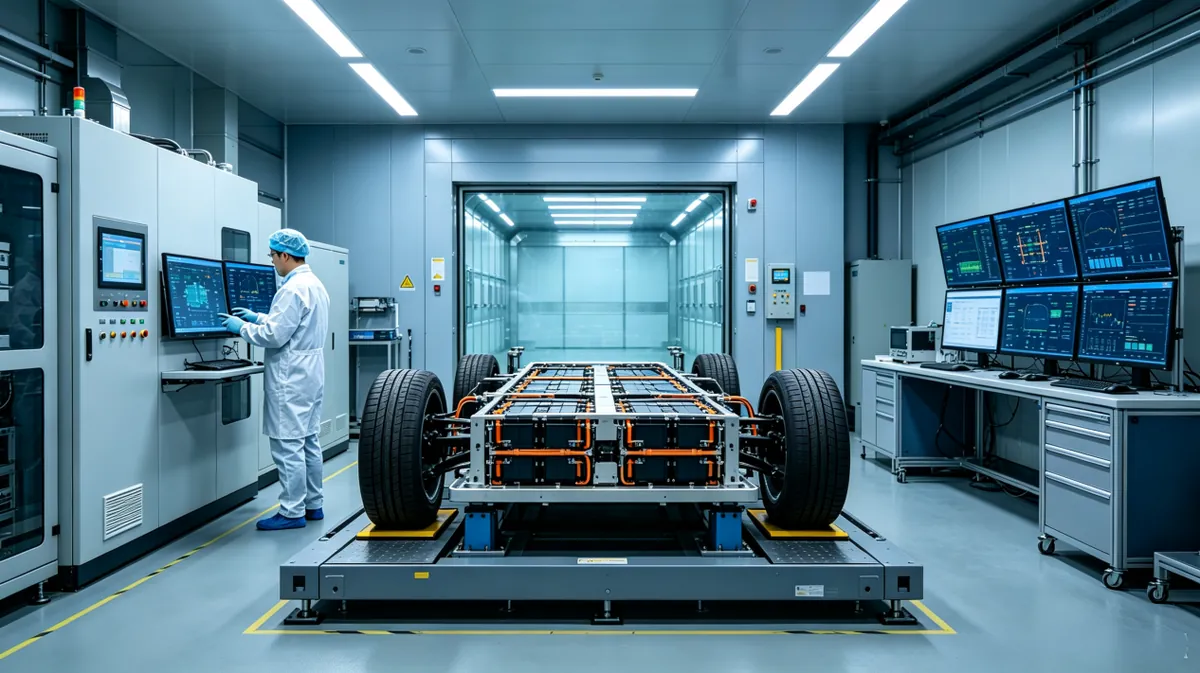
A walk-in ageing chamber, model HR-TH-14280LLWRR2, with roughly 14 m³ of usable volume. Horizontal air supply from both sides with top return keeps uniformity at full load. Independent over-temperature protection, smoke detection and a pressure-relief vent provide the safety margin battery ageing requires, and 16 internal temperature channels feed the HURECO monitoring system.
Implementation and validation
After floor levelling, 380 V power and exhaust connection, the site ran a 72-hour no-load uniformity test, a loaded ramp-rate test at 120 modules, and a power-loss recovery test. Loaded steady-state uniformity measured ±1.5 °C, better than the ±2 °C in the contract.
Outcome
Ageing now takes 28 days instead of 35–40 days outsourced. A suspect module can be traced to a specific rack position and time window inside the plant, and curves, over-temperature alarms and batch records are archived automatically, so traceability no longer depends on paper logs.
Customer feedback
The line quality manager put it simply: after commissioning, ageing scheduling finally worked on demand, and the data went straight into the quality system — no more back-and-forth with an outside lab.
- Walk-in ageing chamber HR-TH-14280LLWRR2