HURECO Monitoring V1.0
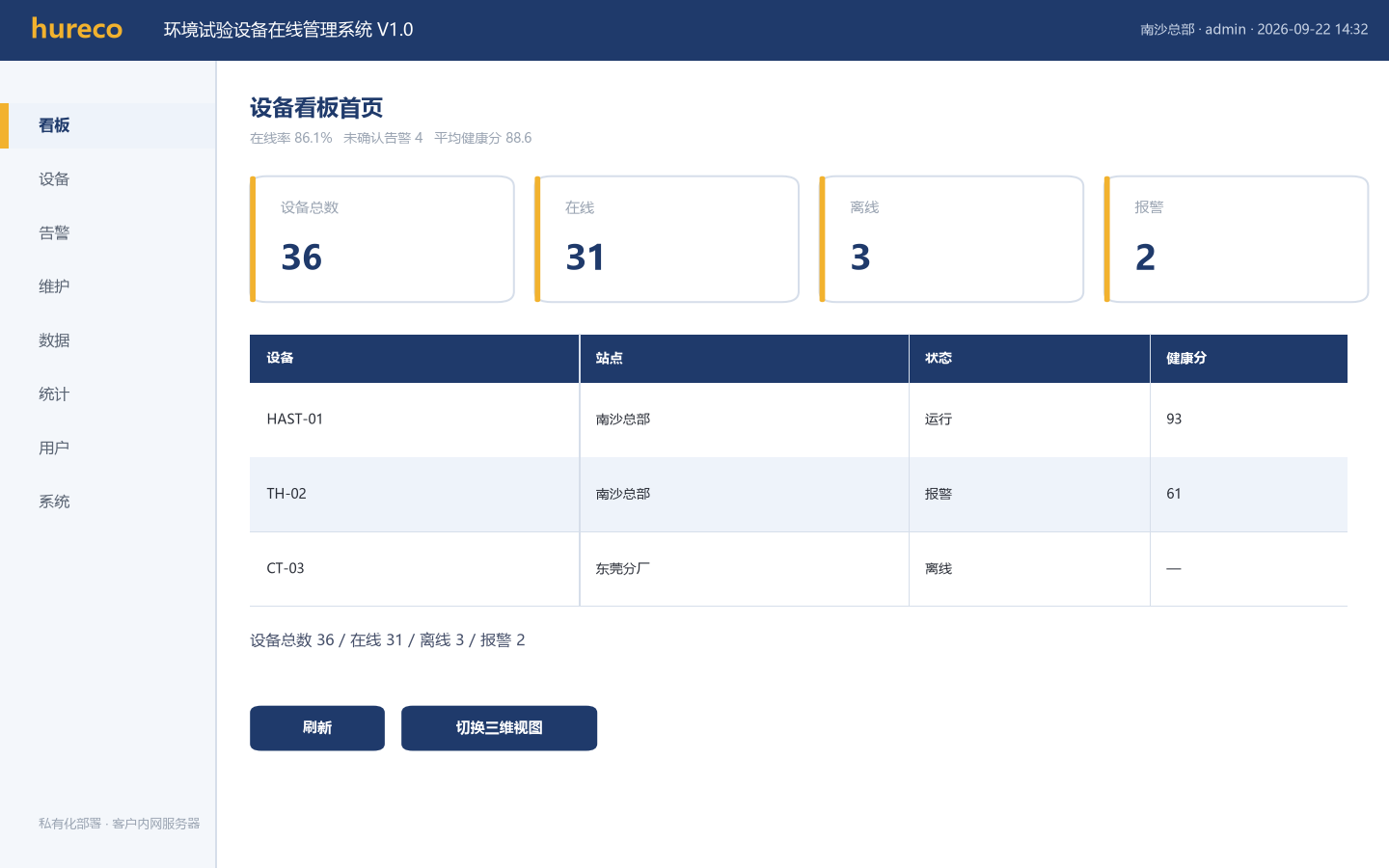
Centralised monitoring and remote maintenance software for environmental chambers. It brings chambers scattered across a workshop onto one platform and continuously aggregates temperature, humidity and run-state data, so equipment status is visible, anomalies are traceable, maintenance is plannable and data is reusable. Supplied with HURECO chambers.
| Deployment | On-premise on the customer intranet server or private cloud, accessed through a browser |
|---|---|
| Data source | Chambers report over MQTT / HTTP through a gateway; unconnected units are shown as offline |
| Alarm channels | In-app message / SMS / email / WeCom, routed by severity and duty roster |
| Delivery | Supplied with HURECO chambers; the number of connected units can be expanded as needed |
Key features
- Live dashboard: run state, current temperature and humidity, and test progress for every chamber on one screen, with drill-down by workshop group
- Graded alarms: over-temperature, over-humidity and communication loss pushed by severity to in-app messages, SMS, email or WeCom
- History: query curves by chamber and time window, export to CSV / Excel / PDF for quality traceability
- Maintenance: preventive maintenance work orders, spare-part stock alerts, energy and OEE statistics, and SLA tracking (availability / MTTR / MTBF)
- Compliance: role-based access combined with data-scope control, full audit trail on critical actions, read-only audit logs
- Open interfaces: RESTful API and MQTT topics for integration with MES, LIMS and in-house systems
Other Monitoring & Test Software
HURECO Software Bundle
Buy a chamber, get the software: the monitoring system (standard edition) and the automated test platform (single-seat licence) ship with the equipment. Perpetual licence, no annual subscription, commissioning and training included.
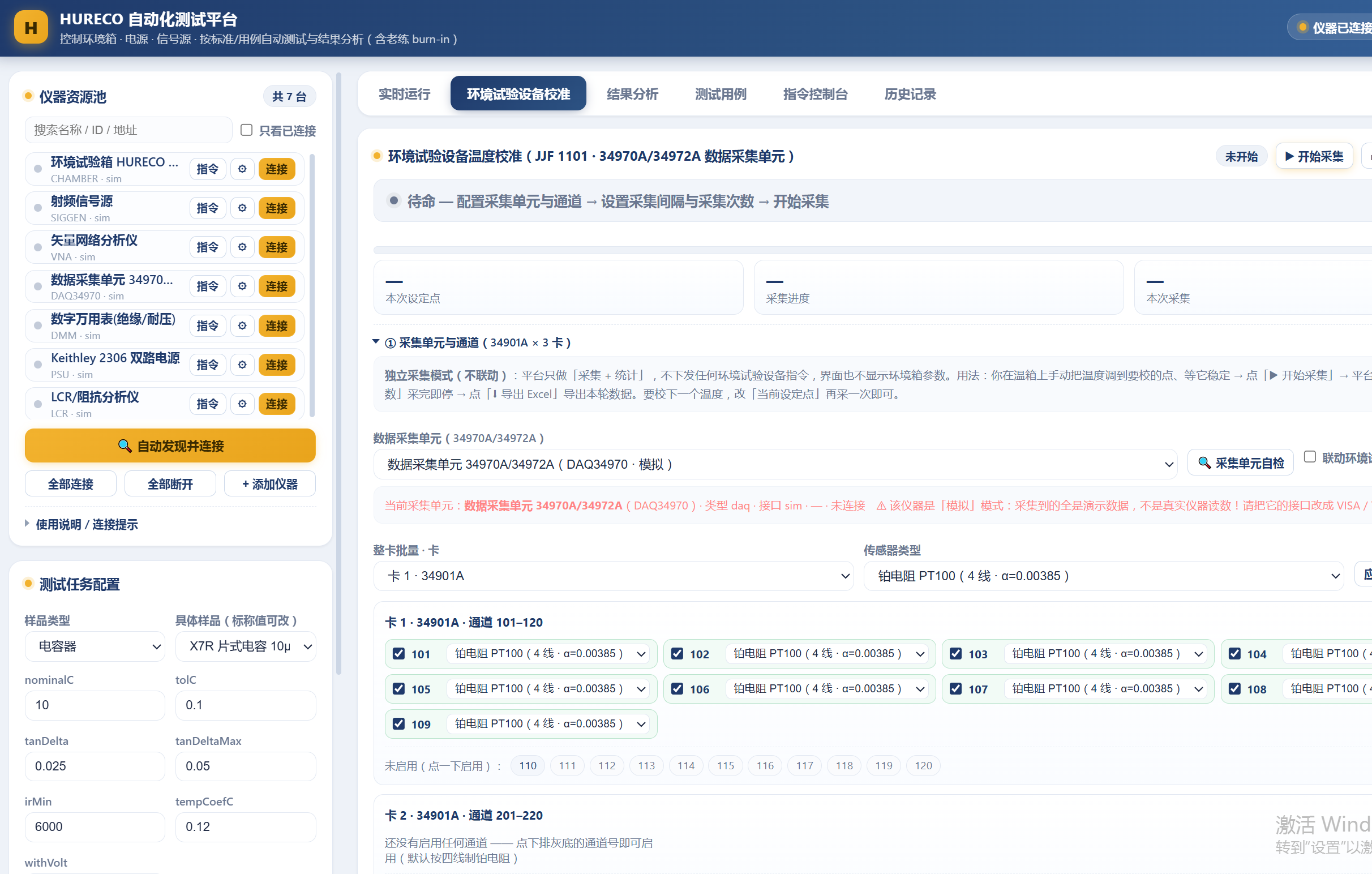
HURECO ATE V1.0
Automated test and data-acquisition software that runs on the industrial PC at the equipment. It drives chambers, power supplies, signal sources and data-acquisition units over standard industrial buses, executes tests from standards and test cases, and analyses the results — including burn-in. A shared interface with the monitoring system forms a two-tier field-to-office data architecture.